About FixMySpeakerLab
About us–Who We Are
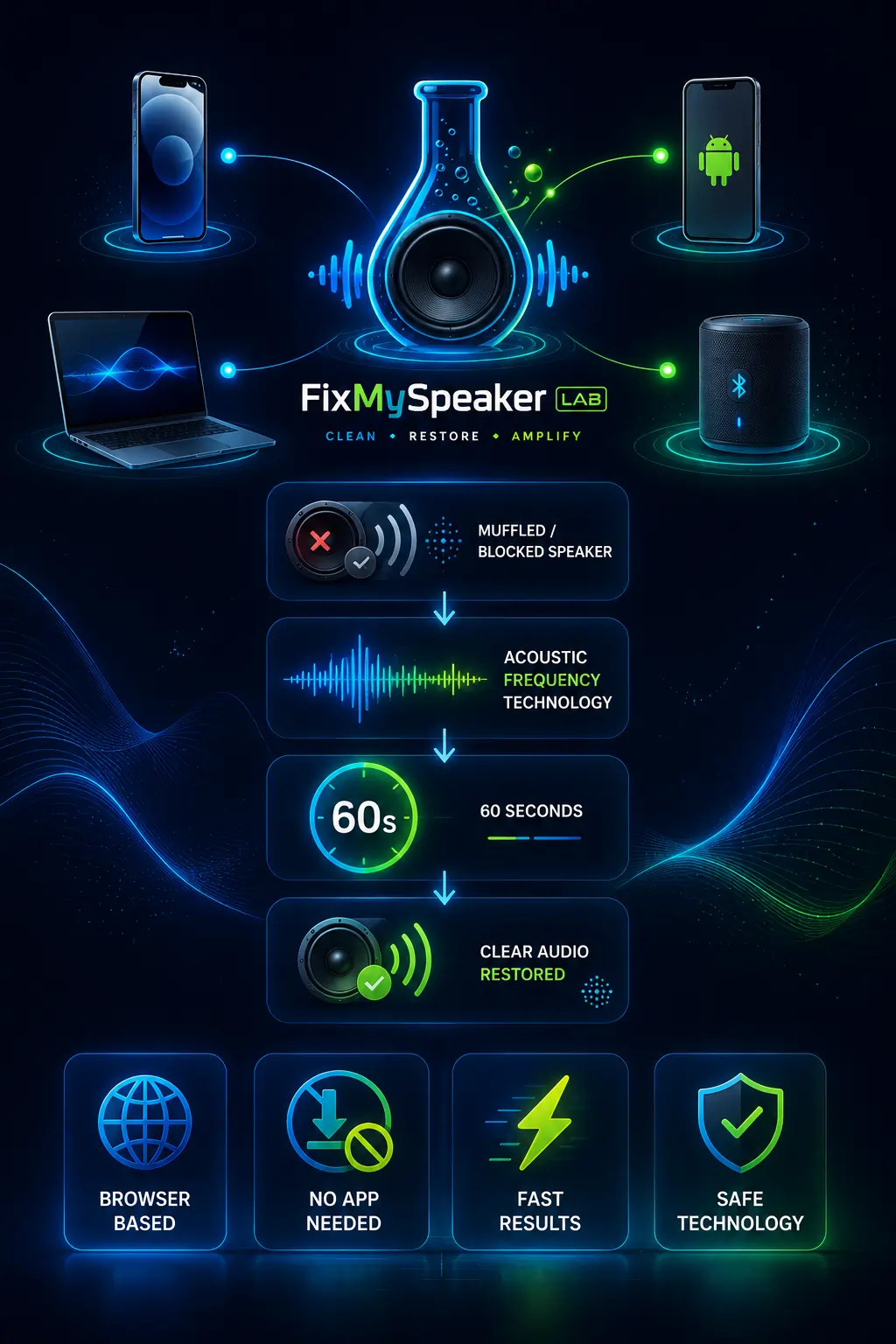
About us-FixMySpeakerLab is a free utility website that helps people fix muffled, water-damaged, and dust-clogged phone speakers using acoustic frequency technology — directly in the browser, in 60 seconds, on any device.
No app store. No download. No login. Just open a tool, press play, and the science does the work.
We are a small independent team that builds practical tools for real problems.
Every tool on this site exists because a user had a broken speaker and deserved a better solution than “put it in rice and wait.”
Our Story
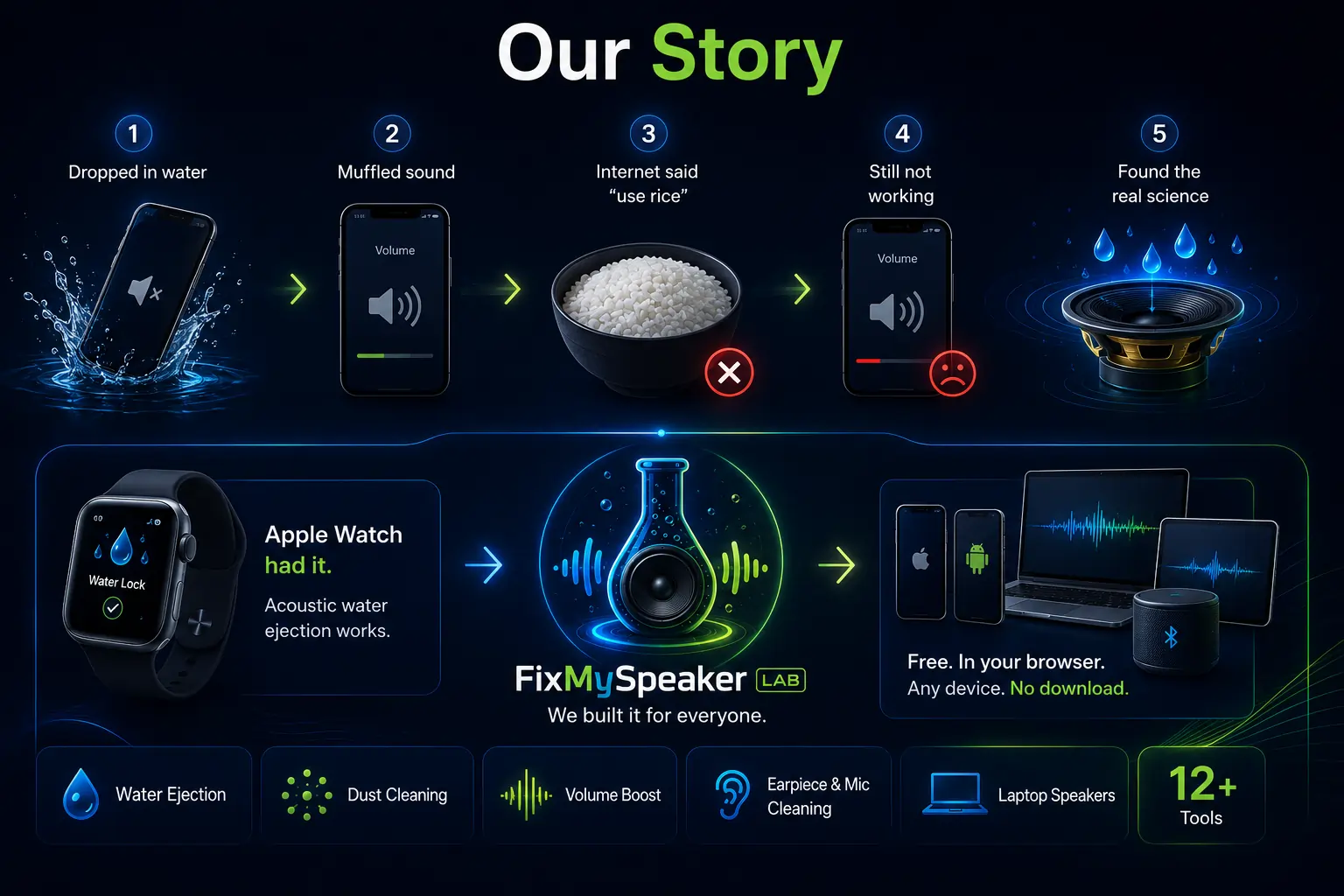
It started with a dropped phone in a sink.
Speaker sounded muffled afterward. The internet recommended rice. Two days later, audio quality was still poor — and research revealed why: rice absorbs ambient humidity, not water adhered to a speaker diaphragm by surface tension. The physics simply do not support it.
That gap between what people recommend and what actually works is what FixMySpeakerLab was built to fill.
Apple had already built acoustic water ejection into Apple Watch. The science was established. What was missing was a free, accessible, browser-based version for smartphones — one that worked on iPhone and Android without an app download, worked in any browser, and explained clearly why it worked.
That is what we built. Twelve tools later, the site covers water damage, dust accumulation, volume loss, earpiece cleaning, mic cleaning, laptop speakers, and device-specific tools for iPhone 12, 13, and more. Every tool uses the same core principle: precision acoustic frequencies matched to speaker membrane resonance, delivered through the browser’s Web Audio API. This is all About us
What We Do
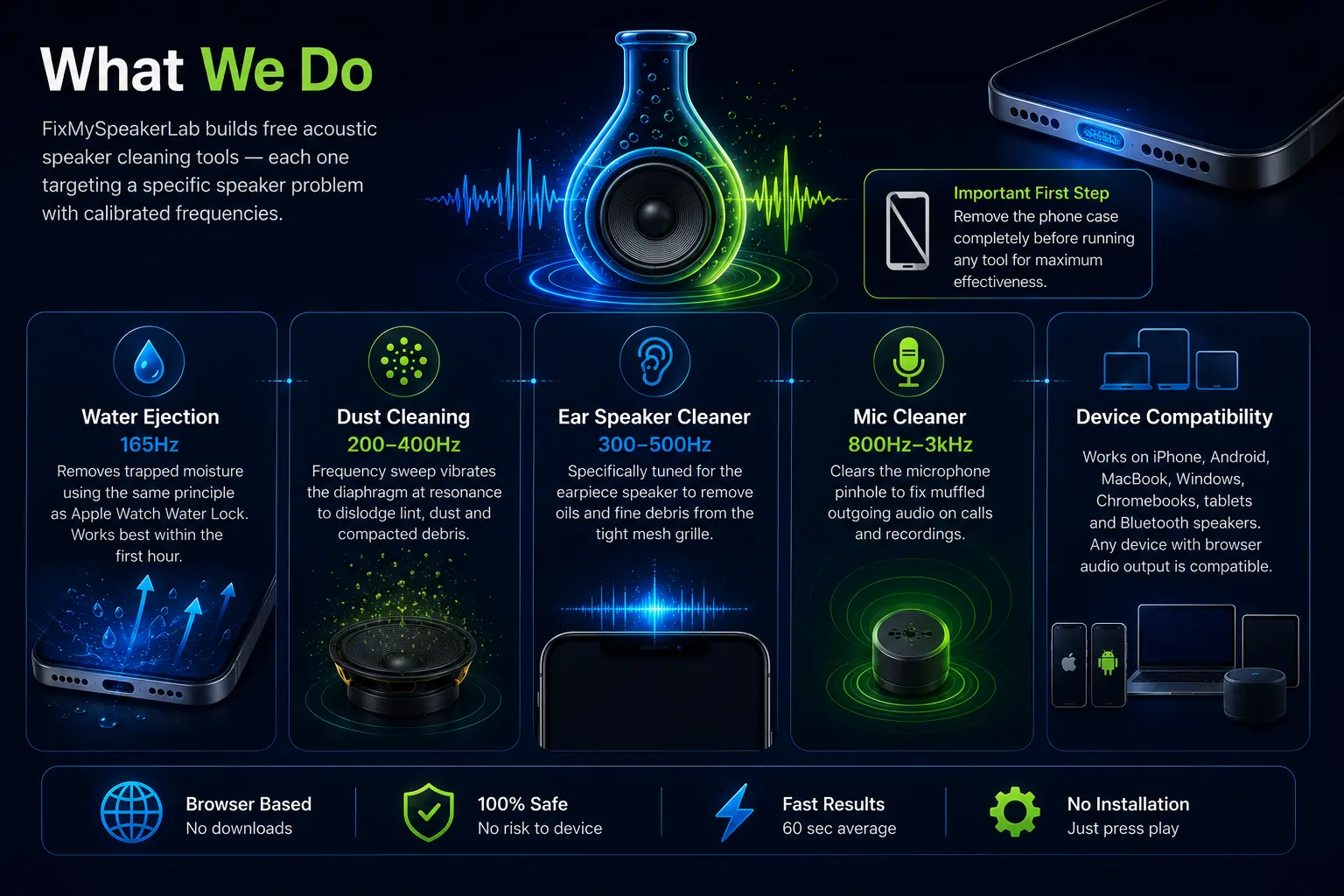
FixMySpeakerLab builds free acoustic speaker cleaning tools — each one targeting a specific speaker problem with frequency ranges calibrated to that problem type.
Water Ejection
165Hz acoustic tone removes trapped moisture from phone speaker chambers using the same ejection principle as Apple Watch Water Lock. Works within the critical first-hour window before mineral deposits form
Before pressing anything: remove the iPhone 12 case completely. Cases absorb vibration and reduce ejection effectiveness by up to 40 percent. Even thin cases dampen the acoustic energy before it reaches the speaker housing. Run every ejection cycle on the bare device.
Dust Cleaning
200–400Hz frequency sweep vibrates the speaker diaphragm at resonance to dislodge lint, dust, and compacted debris without any physical contact with the speaker grille.
Ear Speaker Cleaner
300–500Hz mode specifically tuned for the earpiece speaker — the smaller, tighter-mesh grille used during standard phone calls that accumulates skin oils and fine debris faster than the main speaker.
Mic Cleaner
800Hz–3kHz sweep clears the microphone pinhole — the tiny opening that captures voice on calls and recordings. Fixes muffled outgoing audio that the main speaker tools cannot reach.
Device Compatibility
Every tool works on iPhone, Android, MacBook, Windows laptops, Chromebooks, tablets, and Bluetooth speakers. Any device with browser-accessible audio output is compatible. No installation, no permissions beyond standard audio playback.
Our Mission
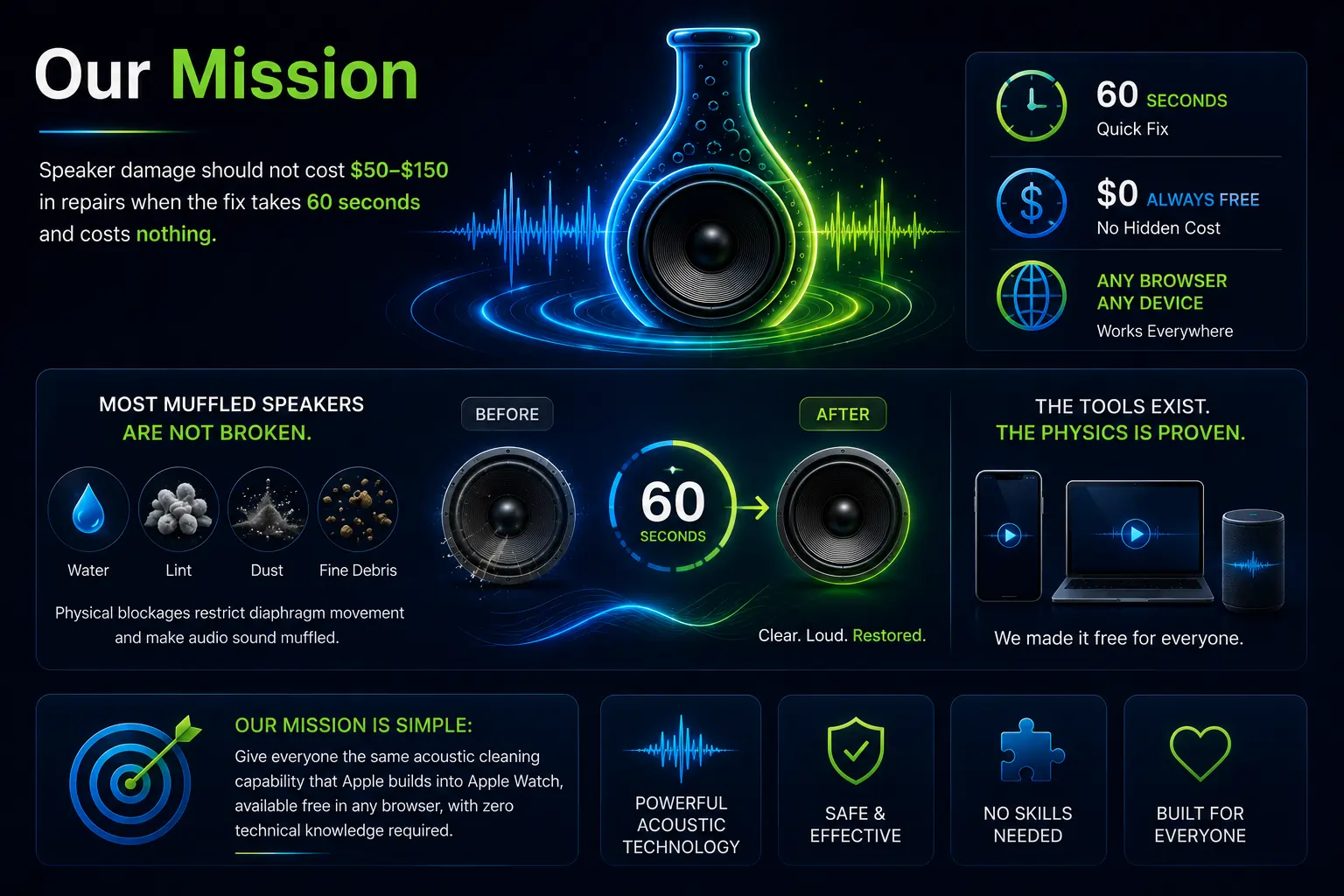
Speaker damage should not cost $50–$150 in repairs when the fix takes 60 seconds and costs nothing.
Most muffled speakers are not broken — they are blocked. Water. Lint. Dust. Fine debris. Physical blockages that restrict diaphragm movement and degrade audio output in ways that feel permanent but almost never are. The tools to fix this exist. The physics is well understood. Making those tools free, accessible, and genuinely effective is the entire purpose of this site.
Our mission is simple: give everyone the same acoustic cleaning capability that Apple builds into Apple Watch, available free in any browser, with zero technical knowledge required.
Why People Trust Us
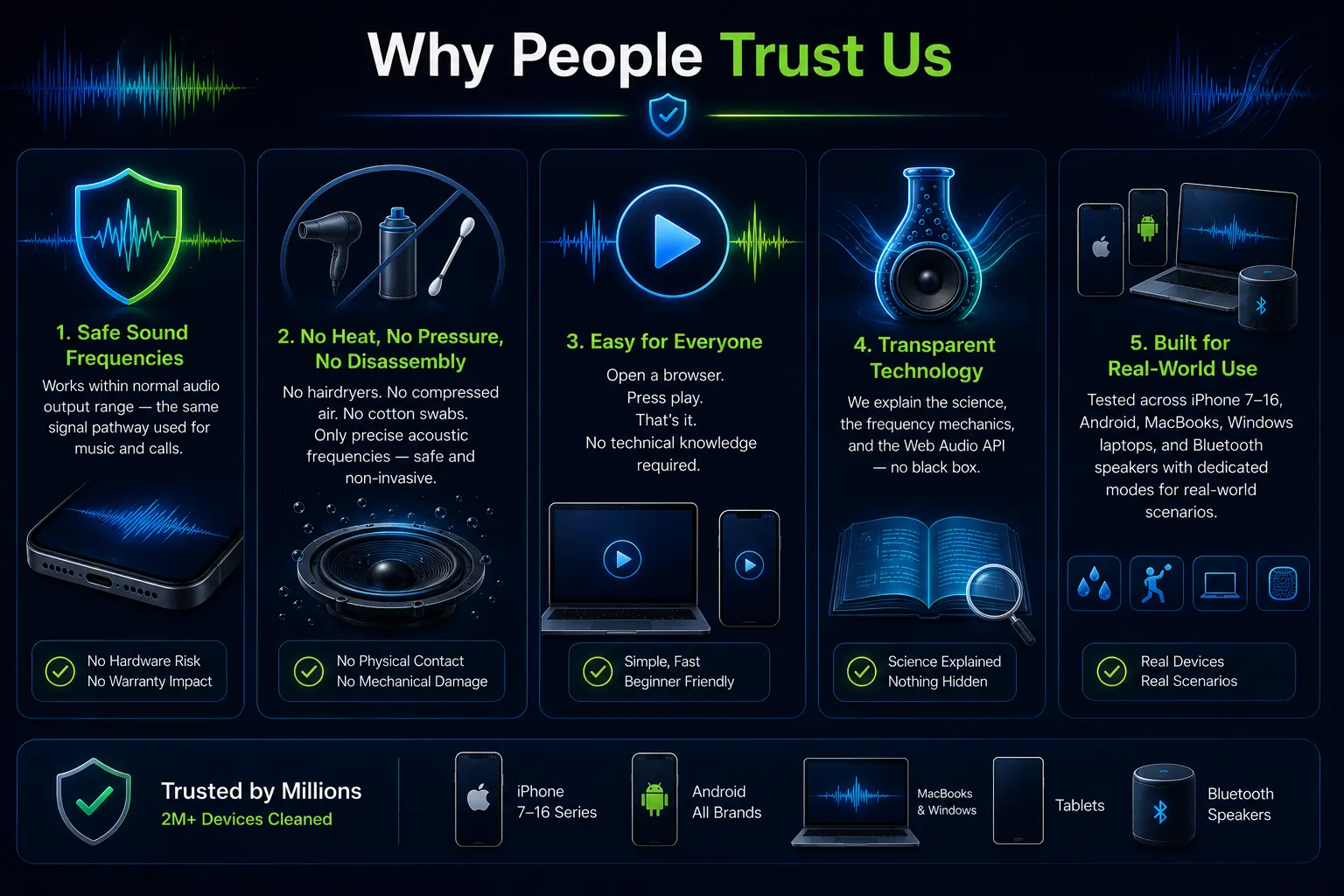
Safe Sound Frequencies
Every tool operates within the normal audio output range of smartphone speakers — identical in electrical terms to music or call audio playback. No hardware risk. No warranty implications. The same signal pathway that plays your music plays the cleaning tone.
No Heat, No Pressure, No Disassembly
Hairdryers warp speaker diaphragms. Compressed air pushes debris deeper. Cotton swabs leave fibers behind. FixMySpeakerLab tools use nothing except precisely calibrated acoustic frequencies — no physical contact, no heat, no risk of mechanical damage to the speaker assembly.
Easy for Everyone
Open a browser. Press play. That is the entire user experience. No technical knowledge required. No settings to configure. The tool handles the frequency selection, the cycle timing, and the two-stage ejection sequence automatically.
Transparent Technology
Every page on this site explains exactly why the tool works — the resonant frequency mechanics, the surface tension physics, the Web Audio API implementation. We do not ask users to trust a black box. The science is documented clearly so users can understand what they are doing, not just follow instructions blindly.
Built for Real-World Use
Tools are tested across iPhone 7 through 16 series, major Android brands, MacBooks, Windows laptops, and Bluetooth speakers. Edge cases — saltwater exposure, sweat accumulation, laptop bottom-firing speakers, earpiece mesh — have dedicated modes rather than one-size-fits-all solutions.
The Technology Behind FixMySpeakerLab
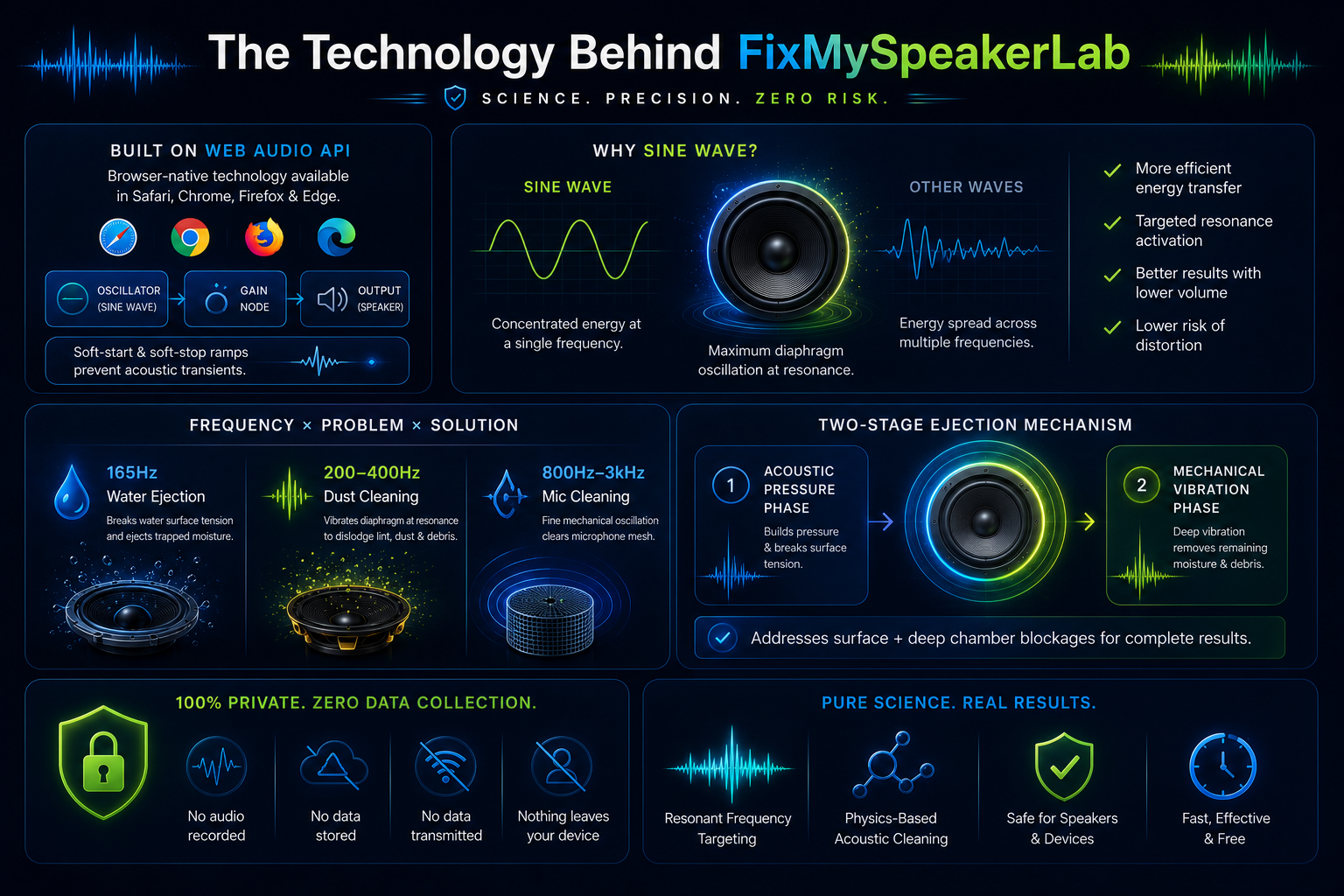
Every tool runs on the Web Audio API — the browser-native audio synthesis interface built into Safari, Chrome, Firefox, and Edge. It generates a pure sine wave oscillator at the target frequency, delivered through a gain node with soft-start and soft-stop ramps to prevent acoustic transients.
Sine wave output is chosen specifically over other waveforms because it concentrates all acoustic energy at a single frequency — the target resonant frequency — rather than distributing it across harmonics. At 165Hz resonance, the diaphragm oscillates with maximum amplitude, creating acoustic pressure that breaks water surface tension. At 200–400Hz, faster vibration cycles dislodge dry debris. At 800Hz–3kHz, fine mechanical oscillation clears microphone mesh.
The two-stage ejection mechanism — acoustic pressure phase followed by mechanical vibration phase — addresses both surface and deep chamber blockages in a single session. This combination is what consistently produces complete results where single-mode tools produce partial improvement.
No data is collected. No audio is recorded. The oscillator output goes directly to the device speaker — nothing is captured, stored, or transmitted.
The acoustic ejection principle used in our tools
is the same technology Apple built into Apple Watch
Water Lock — documented on Apple’s official support page.
Our Commitment to Users
Contact Us
Have a question about a tool, found something not working on your device, or want to suggest a new feature?
📧 [email protected] 🌐 fixmyspeakerlab.com/contact/
We respond within 24 hours on business days. Every message is read directly — no support tickets, no auto-replies.