Water Eject iPhone 13 – Safely Remove Water from Speakers & Restore Clear Sound
Your iPhone 13 speaker sounds muffled after getting wet. Calls are quiet. Music sounds flat. The bass has disappeared. This is not hardware failure — it is water physically restricting the speaker diaphragm, and it is completely reversible if you act within the first hour. The free water eject tool plays a precision 165Hz acoustic tone through your iPhone 13 speaker that breaks the surface tension holding moisture against the diaphragm and pushes it out through the speaker grille — the same ejection principle Apple built into Apple Watch Water Lock, available free in Safari right now.
Start Water Eject for iPhone 13 — Free, 60 Seconds, No Download
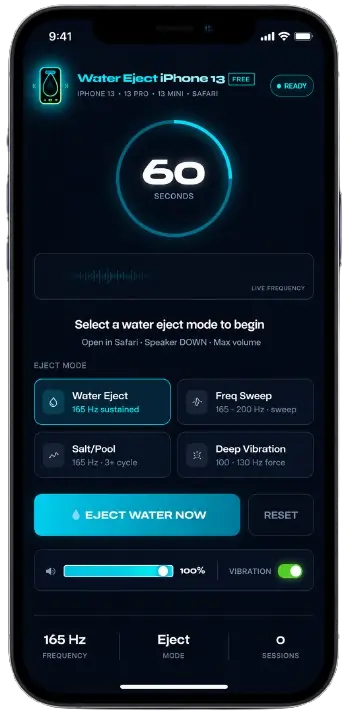
Water Eject iPhone 13FREE
iPhone 13 · 13 Pro · 13 Mini · Safari
iPhone 13 Speaker Cleared ✓
Water ejected · Test audio with Voice Memos
Water Eject iPhone 13 Tool
The Water Eject iPhone 13 tool is a browser-based acoustic ejection system that runs directly in Safari on your iPhone 13. It generates a calibrated 165Hz sine wave tone through the Web Audio API, delivering it to the iPhone 13 speaker hardware to create controlled diaphragm vibration at the membrane’s natural resonant frequency. That vibration produces outward acoustic pressure strong enough to break water surface tension and propel moisture through the speaker grille opening.
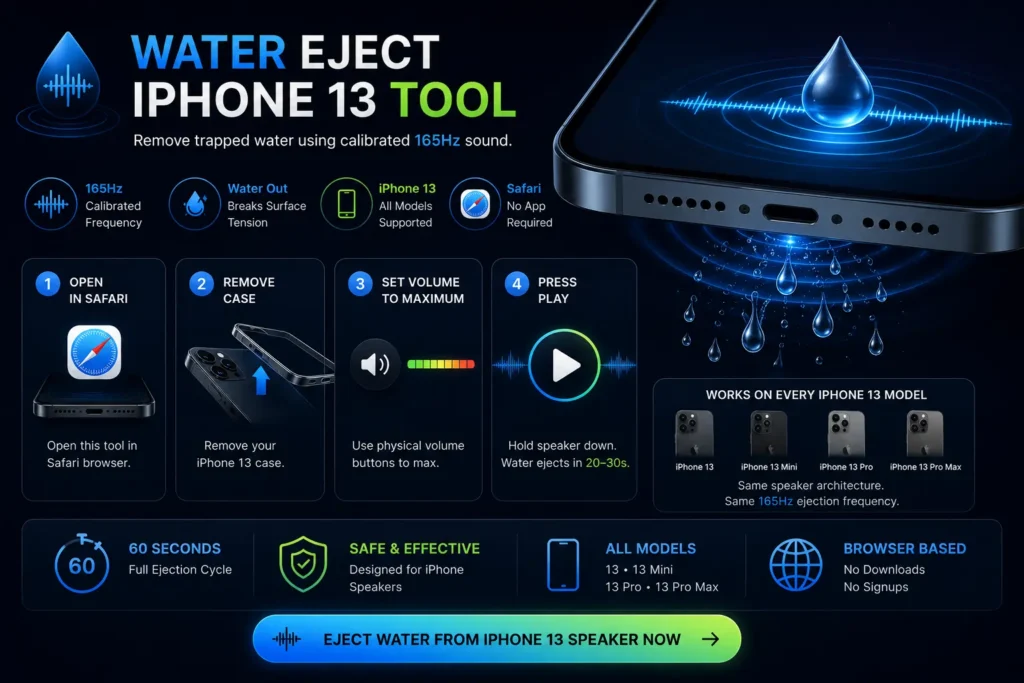
Open in Safari. Remove your case. Set volume to maximum using the physical buttons. Hold the iPhone 13 with the speaker facing downward. Press play. Visible water droplets typically exit the grille within the first 20–30 seconds.
Works on every iPhone 13 model — iPhone 13, iPhone 13 Mini, iPhone 13 Pro, and iPhone 13 Pro Max. All have the same speaker architecture and respond identically to the 165Hz ejection frequency.
Eject Water from iPhone 13 Speaker Now
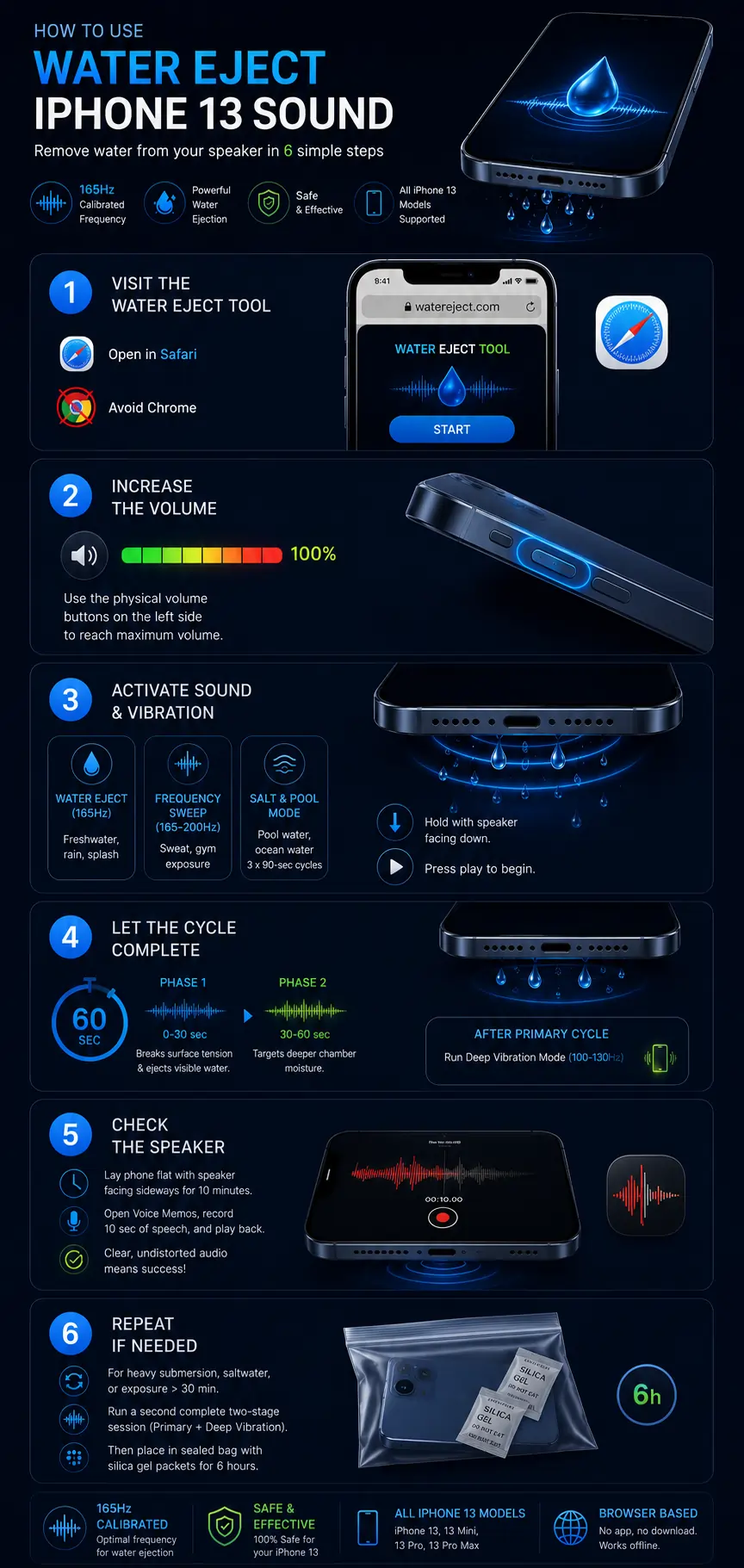
How to Use Water Eject iPhone 13 Sound to Remove Water
Step 1 — Visit the Water Eject Tool
Open Safari on your iPhone 13 and navigate to the tool page. Do not use Chrome on iOS — Chrome adds an audio processing layer between the Web Audio API and the hardware speaker that reduces acoustic pressure output. Safari has direct hardware audio access on iOS, which means the full 165Hz ejection tone reaches the iPhone 13 speaker driver at full amplitude without any signal reduction and clean complete the process of Water Eject iPhone 13.
Before you begin Water Eject iPhone 13: remove the iPhone 13 case completely. Cases absorb vibration and block acoustic energy from the speaker grille, reducing ejection effectiveness by up to 40 percent. A case-free iPhone 13 gives the ejection tone full access to the speaker housing.
Step 2 — Increase the Volume
Use the physical volume buttons on the left side of the iPhone 13 to raise volume to 100 percent. Do not adjust volume through the Control Centre slider — physical button maximum volume ensures the system audio output is uncapped. Maximum volume is the baseline requirement for effective water ejection. At 50 percent volume the acoustic pressure is insufficient to overcome the surface tension holding water droplets against the iPhone 13 diaphragm and speaker mesh. Full volume is not optional.
Step 3 — Activate Sound and Vibration
Select the appropriate mode for your exposure type. For standard freshwater, rain, or splash — use Water Eject mode at 165Hz. For sweat or gym exposure — use Frequency Sweep at 165–200Hz to account for the slightly higher viscosity of sweat. For pool water or ocean water — use Salt & Pool Mode which runs three consecutive 90-second ejection cycles to maximize moisture removal before mineral deposits from dissolved compounds can form on the diaphragm surface.
Hold the Water Eject iPhone 13 with the bottom speaker grille facing straight down toward the floor. Gravity and acoustic pressure both direct moisture toward the grille opening when the phone is in this orientation — together they produce significantly faster ejection than horizontal placement.
Press play to begin.
Step 4 — Let the Cycle Complete
Do not interrupt the cycle. The full 60-second run is designed in two phases: the first 30 seconds use acoustic pressure at 165Hz to break surface tension on moisture adhered to the diaphragm face and speaker mesh — you will likely see visible water droplets exiting the iPhone 13 grille at this stage. The final 30 seconds target deeper chamber moisture that the initial phase loosened but did not fully expel. Stopping early cuts this second phase short and leaves residual moisture inside the speaker housing.
After the primary cycle completes, immediately run Deep Vibration mode.
This second stage uses 100–130Hz mechanical force that propagates through the Water Eject iPhone 13 speaker housing itself — reaching moisture the acoustic pressure phase dislodged but could not expel. Running both stages together in one session produces consistently more complete water removal than the acoustic phase alone.
Step 5 — Check the Speaker
After both cycles complete, lay the iPhone 13 flat with the speaker grille facing sideways for 10 minutes. Then test audio by opening the Voice Memos app, recording 10 seconds of speech, and playing it back at medium volume. Voice recording reveals mid-frequency clarity and residual muffling more accurately than music — music’s bass and treble content can mask partial muffling that voice recording makes immediately obvious.
Clear, undistorted playback at normal volume confirms the water ejection was successful. If audio still sounds slightly muffled, proceed to Step 6. Full audio restoration is the expected outcome for water exposure caught within the first hour.
Step 6 — Repeat if Needed
For heavy submersion, saltwater exposure, or water that had been in the iPhone 13 speaker for more than 30 minutes before ejection began, run a second complete two-stage session — primary mode followed by Deep Vibration. After the second session, place the iPhone 13 in a sealed bag with silica gel packets for 6 hours. Silica gel absorbs residual water vapor that acoustic ejection cannot reach — the microscopic moisture film on internal surfaces after liquid water has been expelled. This follow-up step is particularly important after pool water or sweat exposure where dissolved compounds remain on speaker surfaces.
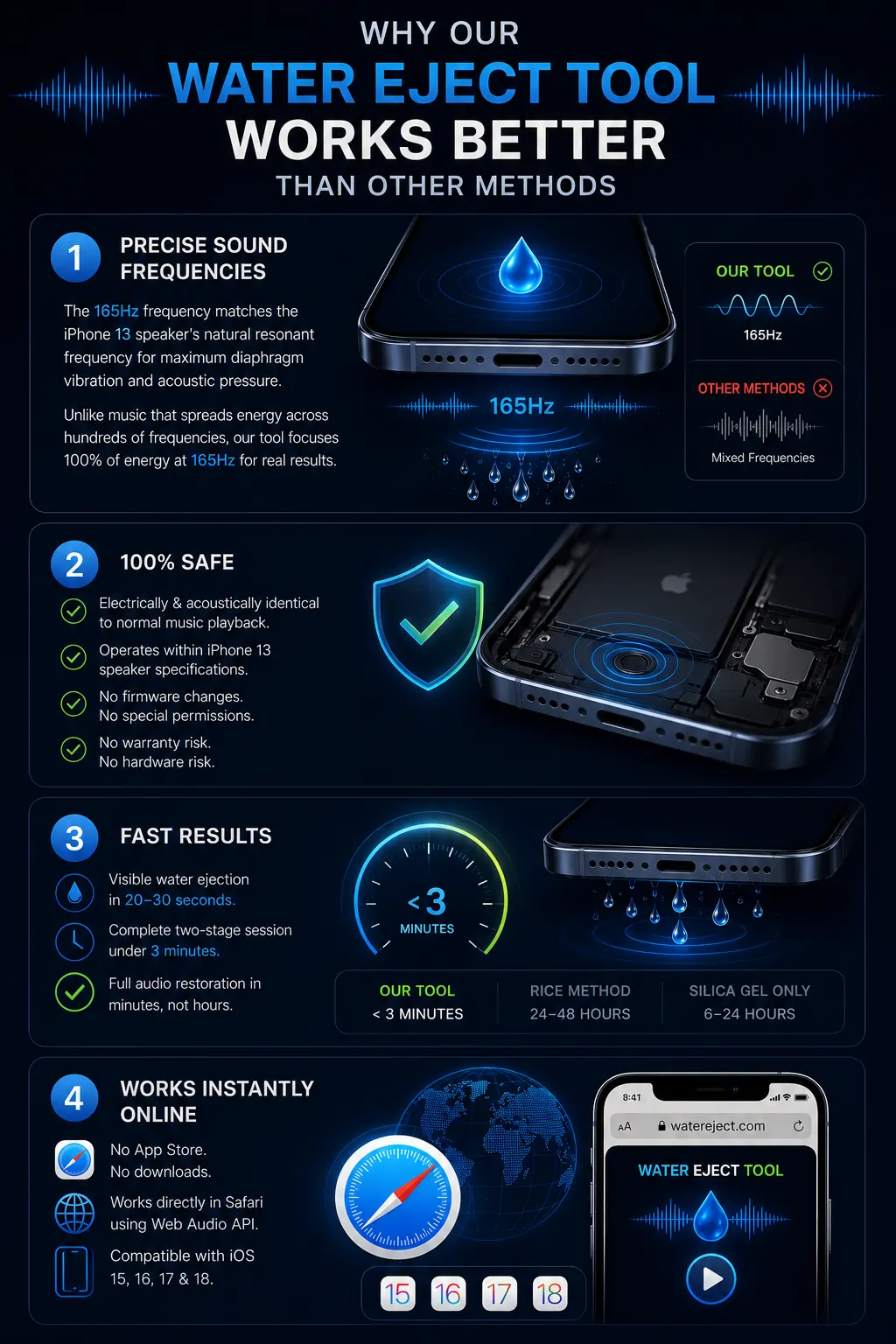
Why Our Water Eject Tool Works Better Than Other Methods–Water Eject iPhone 13
Precise Sound Frequencies
The 165Hz ejection frequency is not arbitrary. It matches the natural resonant frequency of the iPhone 13 speaker membrane — the vibration rate at which the diaphragm oscillates with maximum amplitude. At resonance, the diaphragm generates acoustic pressure significantly stronger than normal audio playback at the same volume level.
That amplified pressure is what overcomes water surface tension and produces ejection. Generic loud music distributes acoustic energy across hundreds of frequencies simultaneously — none of which may hit the iPhone 13 membrane’s resonant peak. The water eject tool concentrates all acoustic energy at 165Hz, which is why it produces ejection where music playback does not.
100% Safe
The 165Hz tone the tool generates is electrically and acoustically identical to bass content in standard music playback. It operates within the normal output specifications of the iPhone 13 speaker driver. No firmware modification, no hardware diagnostic access, no elevated system permissions. The iPhone 13 speaker plays bass music at maximum volume routinely — the water eject tone is the same signal type. No warranty risk. No hardware risk on any intact iPhone 13 model.
Fast Results
One complete two-stage session takes under 3 minutes. Visible water droplets exit the iPhone 13 speaker grille within the first 20–30 seconds of the primary cycle on most devices. Full audio restoration for standard freshwater exposure is typically confirmed within 5 minutes of starting. Compare this to the rice method — 24 to 48 hours of passive waiting — or silica gel drying alone — 6 to 24 hours — neither of which actively removes liquid water from inside the speaker chamber.
Works Instantly Online
No App Store visit. No storage used on the iPhone 13. No account creation. Open Safari, navigate to the tool, press play. The Web Audio API is built into every version of iOS Safari — the tool works identically on iOS 15, 16, 17, and 18 without any updates or installations required.
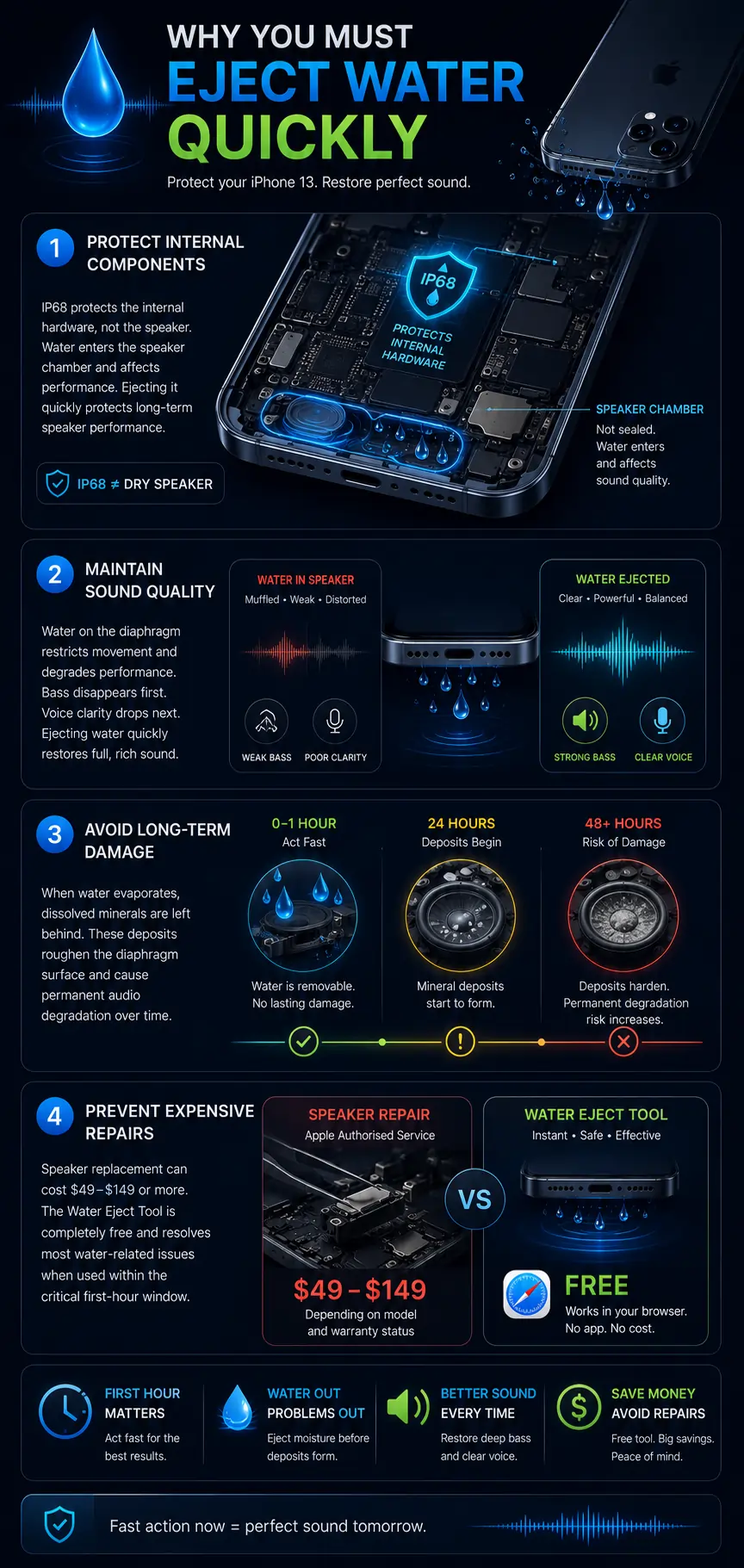
Why You Must Eject Water Quickly
Protect Internal Components
The iPhone 13 carries an IP68 water resistance rating — it can survive submersion up to 6 meters for 30 minutes without internal hardware damage. What the IP68 rating does not prevent is moisture entering the speaker chamber and affecting acoustic performance-Water Eject iPhone 13.
The speaker grille is not sealed. Water enters during submersion and adheres to the diaphragm surface through surface tension. The IP68 certification protects the circuit board and battery — not the acoustic output quality. Ejecting that moisture quickly protects the long-term performance of the speaker driver even on a water-resistant device.
Maintain Sound Quality
The Water Eject iPhone 13 speaker system is engineered for balanced stereo output with strong bass response and clear voice reproduction. Water on the diaphragm restricts membrane movement and immediately degrades this performance — bass frequencies disappear first because they require the most diaphragm excursion, then voice clarity drops.
Every hour water remains inside the chamber is an hour where the speaker operates below its designed specification. Acoustic ejection within the first hour restores full performance before the damage becomes anything more than temporary.
Avoid Long-Term Damage
As water evaporates from the Water Eject iPhone 13 speaker chamber over 24–48 hours, dissolved minerals it carried remain as dry deposits on the diaphragm surface. In tap water, pool water, and sweat — all of which contain dissolved mineral compounds — these deposits gradually roughen the membrane surface and permanently alter how the diaphragm moves.
Audio quality that declines slowly over weeks following a water exposure event is almost always caused by mineral deposit accumulation rather than immediate hardware damage. Acoustic ejection before evaporation removes water while it is still liquid, carrying dissolved minerals out with it before deposits can form.
Prevent Expensive Repairs
Water Eject iPhone 13 speaker replacement at an Apple Authorised Service Provider costs between $49 and $149 depending on the model variant and warranty status. Out-of-warranty liquid damage repair is not covered by Apple’s standard warranty. The water eject tool costs nothing and resolves the majority of water-related iPhone 13 speaker problems when used within the critical first-hour window. Acting immediately is the most cost-effective decision available.
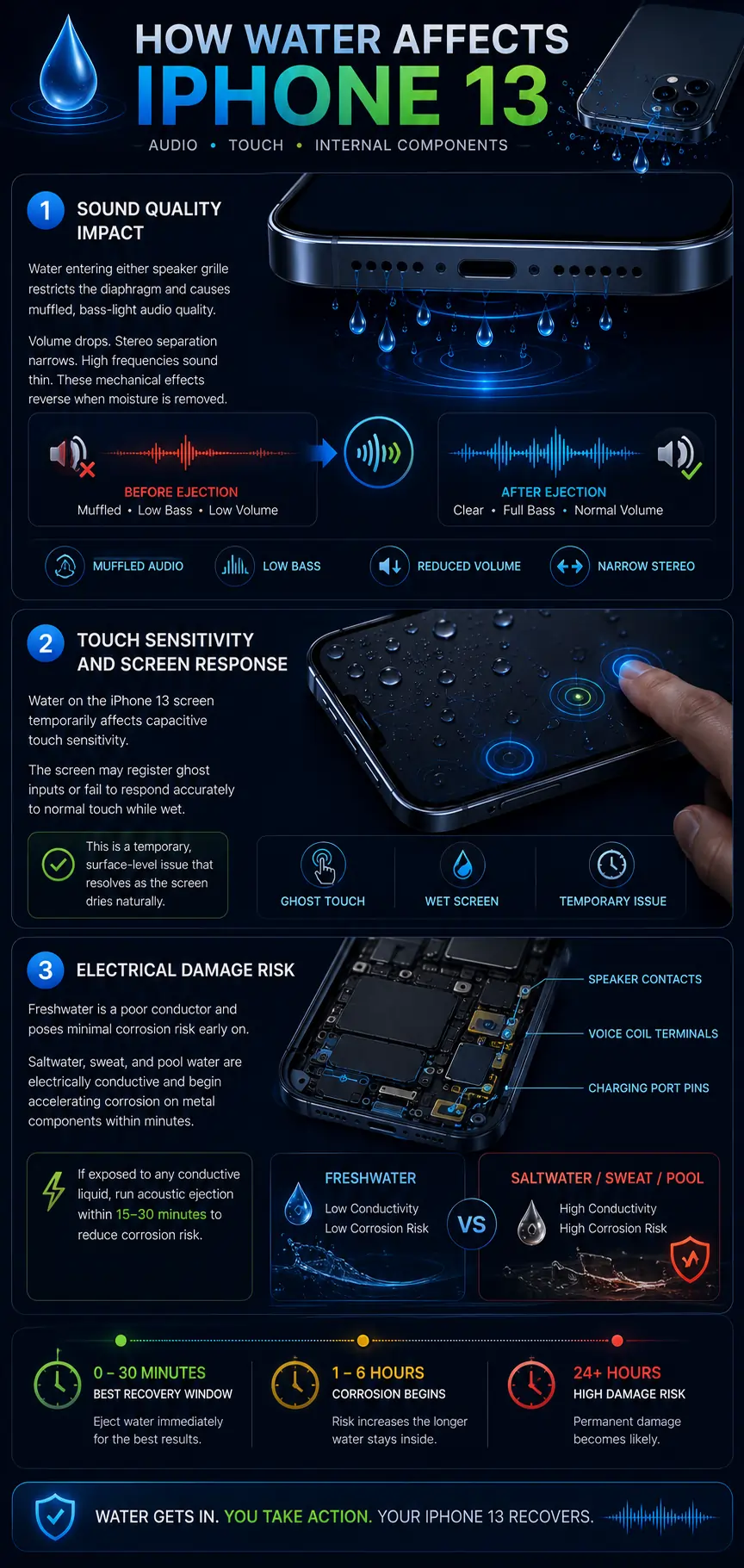
How Water Affects Your iPhone 13
Sound Quality Impact
The iPhone 13 uses a dual-speaker system — the bottom speaker handles the majority of media audio while the earpiece speaker at the top provides the second stereo channel. Water entering either speaker grille restricts the corresponding diaphragm and creates the characteristic muffled, bass-light audio quality that iPhone 13 users describe after water exposure. Volume drops. Stereo separation narrows. High frequencies sound thin. These are all direct mechanical consequences of diaphragm restriction — all of which reverse when the moisture is removed.
Touch Sensitivity and Screen Response
Water on the iPhone 13 screen temporarily affects capacitive touch sensitivity — the screen may register ghost inputs or fail to respond accurately to normal touch while wet. This is a surface phenomenon that resolves as the screen dries and is not related to the speaker problem. Focus on speaker ejection first since the damage window is narrower, then allow the screen to dry naturally.
Electrical Damage Risk
Freshwater is a poor electrical conductor and causes minimal corrosion risk within the first few hours. Saltwater, sweat, and pool water are electrically conductive and begin accelerating corrosion on metal iPhone 13 components — speaker contacts, voice coil terminals, and charging port pins — within minutes of contact. If the iPhone 13 was exposed to any conductive liquid, running acoustic ejection within 15–30 minutes dramatically reduces the corrosion risk compared to waiting for natural drying.
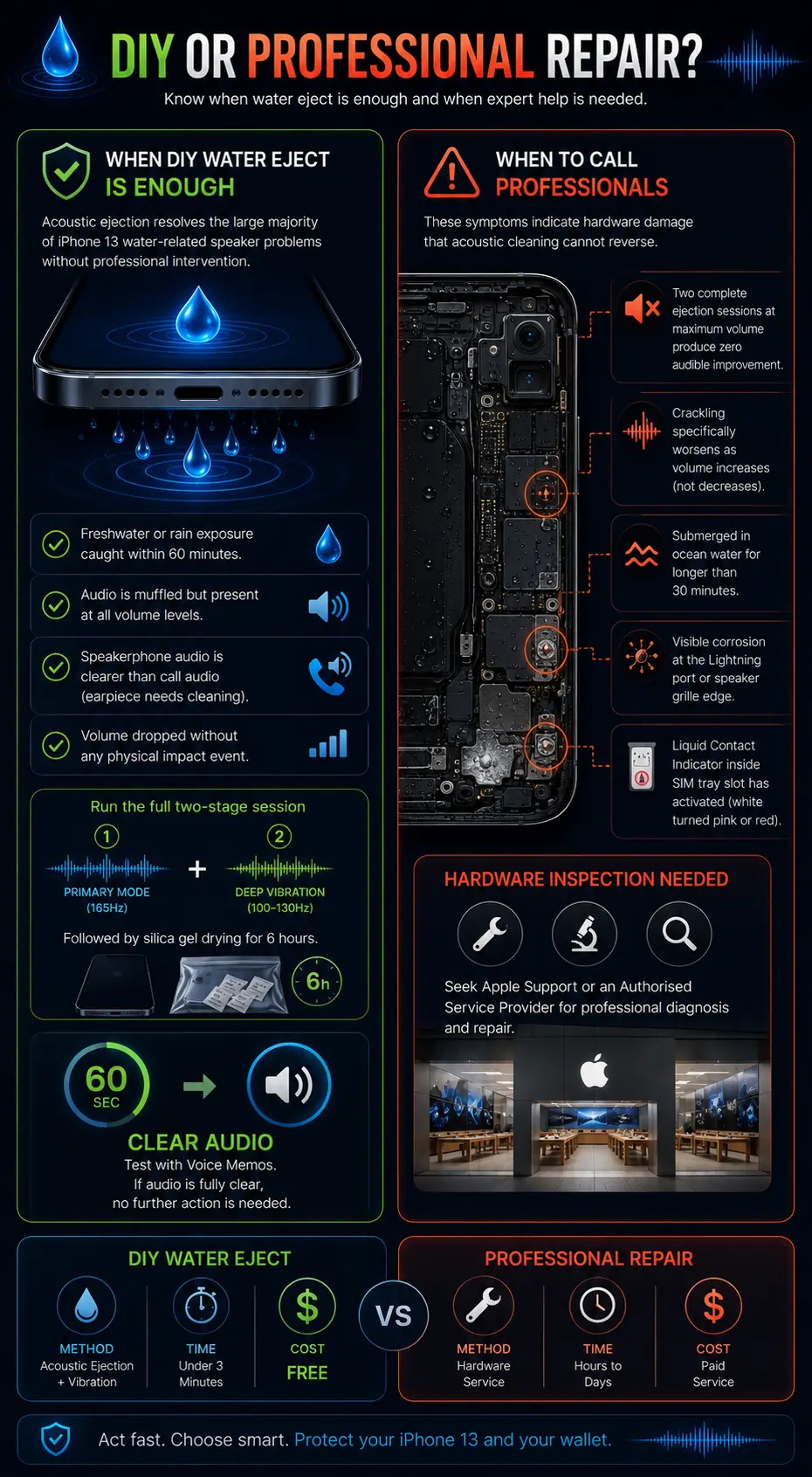
When DIY Water Eject Is Enough
Acoustic ejection resolves the large majority of Water Eject iPhone 13 water-related speaker problems without professional intervention. Use the tool and expect full recovery when: the exposure was freshwater or rain caught within 60 minutes, audio is muffled but present at all volume levels, speakerphone audio is clearer than call audio (confirming the earpiece specifically needs cleaning), or volume dropped without any physical impact event.
Run the full two-stage session — primary mode plus Deep Vibration — followed by silica gel drying for 6 hours. Test with Voice Memos. If audio is fully clear, no further action is needed.
When to Call Professionals
Seek Apple Support or an Authorised Service Provider when: two complete ejection sessions at maximum volume produce zero audible improvement, crackling specifically worsens as volume increases (not decreases), the iPhone 13 was submerged in ocean water for longer than 30 minutes, visible corrosion appears at the Lightning port or speaker grille edge, or the Liquid Contact Indicator inside the SIM tray slot has activated (white indicator turned pink or red). These symptoms indicate hardware damage that acoustic cleaning cannot reverse.Water Eject iPhone 13
Extra Safety Tips for Water Removal
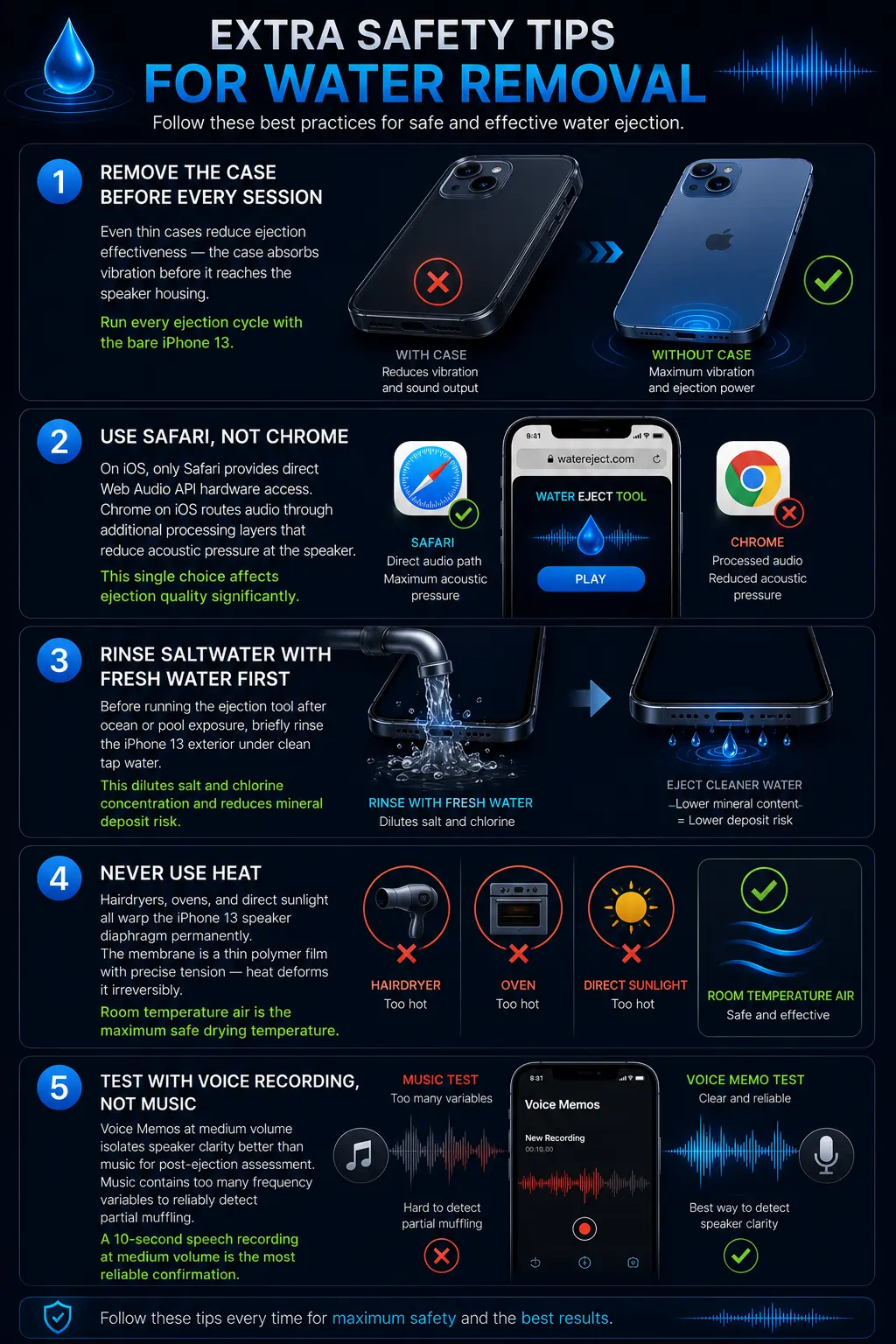
Remove the case before every session. Even thin cases reduce ejection effectiveness — the case absorbs vibration before it reaches the speaker housing. Run every ejection cycle with the bare iPhone 13.
Use Safari, not Chrome. On iOS, only Safari provides direct Web Audio API hardware access. Chrome on iOS routes audio through additional processing layers that reduce acoustic pressure at the speaker. This single choice affects ejection quality significantly.
Rinse saltwater with fresh water first. Before running the ejection tool after ocean or pool exposure, briefly rinse the iPhone 13 exterior under clean tap water. This dilutes salt and chlorine concentration on the speaker grille surface so that lower-salinity water exits during ejection rather than concentrated brine — reducing mineral deposit risk.
Never use heat. Hairdryers, ovens, and direct sunlight all warp the iPhone 13 speaker diaphragm permanently. The membrane is a thin polymer film with precise tension — heat deforms it irreversibly. Room temperature air is the maximum safe drying temperature for iPhone 13 speakers.
Test with voice recording, not music. Voice Memos at medium volume isolates speaker clarity better than music for post-ejection assessment. Music contains too many frequency variables to reliably detect partial muffling. A 10-second speech recording played back clearly at medium volume is the most reliable confirmation of successful water ejection.
Internal & Helpful Resources
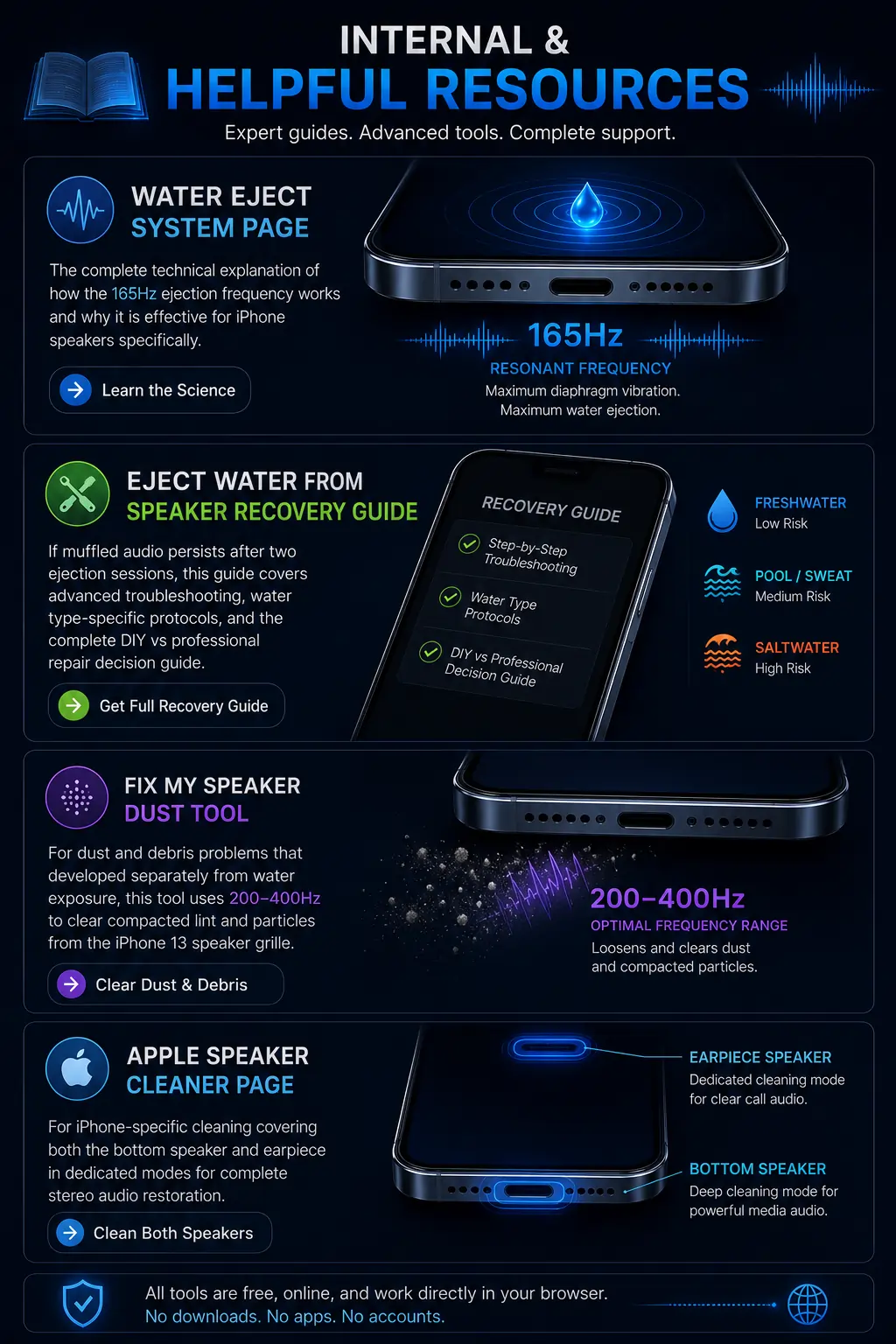
For the complete technical explanation of how the 165Hz ejection frequency works and why it is effective for iPhone speakers specifically, visit the Water Eject system page.
If muffled audio persists after two ejection sessions, the Eject Water from Speaker recovery guide covers advanced troubleshooting, water type-specific protocols, and the complete DIY vs professional repair decision guide.
For dust and debris problems that developed separately from water exposure, the Fix My Speaker Dust tool uses 200–400Hz to clear compacted lint and particles from the iPhone 13 speaker grille.
For iPhone-specific cleaning covering both the bottom speaker and earpiece in dedicated modes, see the Apple Speaker Cleaner page.
FAQs
Conclusion — Act Now, Restore Full Audio
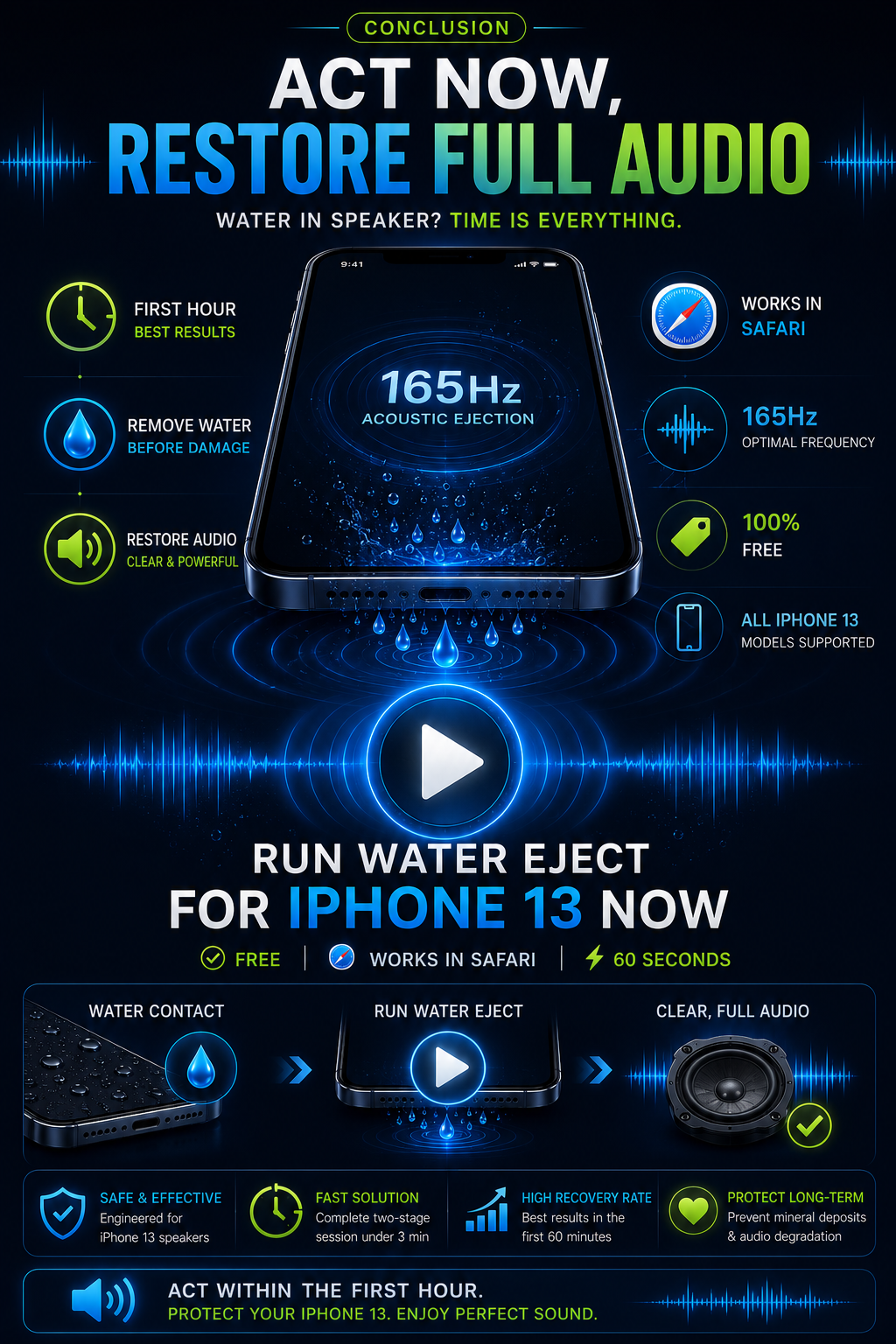
Water in an iPhone 13 speaker is a timing problem above all else. The 165Hz acoustic ejection mechanism works best on liquid water before evaporation converts it to mineral deposits on the diaphragm surface. Within the first 60 minutes, the recovery rate for freshwater exposure is consistently high with a single two-stage session. Beyond that window, results are still good but require more sessions and more drying time.
The tool is free, runs in Safari, and takes under 3 minutes for a complete two-stage session. Run it immediately after any water contact — rain, pool, sweat, or accidental submersion. Test with Voice Memos after drying. For the iPhone 13’s long-term audio quality, acting within the first hour is the single most effective maintenance decision you can make.
Run Water Eject for iPhone 13 Now — Free, Works in Safari, 60 Seconds
Apple confirms that iPhone 13 speakers can be affected
by water exposure despite IP68 rating — detailed in
their official iPhone environmental specifications page.
For dust and debris cleaning on iPhone 13 beyond
water damage, the Apple speaker cleaner covers both
bottom speaker and earpiece in dedicated modes.