Speaker Dust Cleaning Sound – Get Rid of Dust & Enjoy Clear, Crisp Audio
That gradual drop in volume you have been ignoring for weeks? That slight muffling on calls? That flat, thin sound where bass used to be? None of it is normal aging — it is dust. Fine particles from pockets, bags, and the air around you pack into the speaker grille every single day. Speaker dust cleaning sound uses targeted acoustic frequencies to vibrate that buildup loose and push it out through the same grille it entered — no tools, no disassembly, no cost. Press play and hear the difference in under 60 seconds.
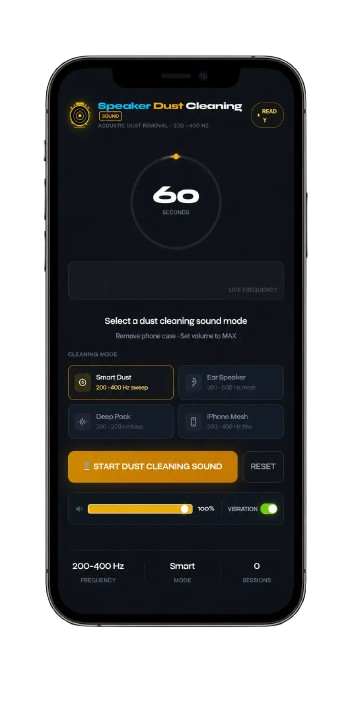
Speaker Dust CleaningSOUND
Acoustic Dust Removal · 200–400 Hz
Dust Cleared ✓
Speaker grille clean · Crystal-clear audio restored
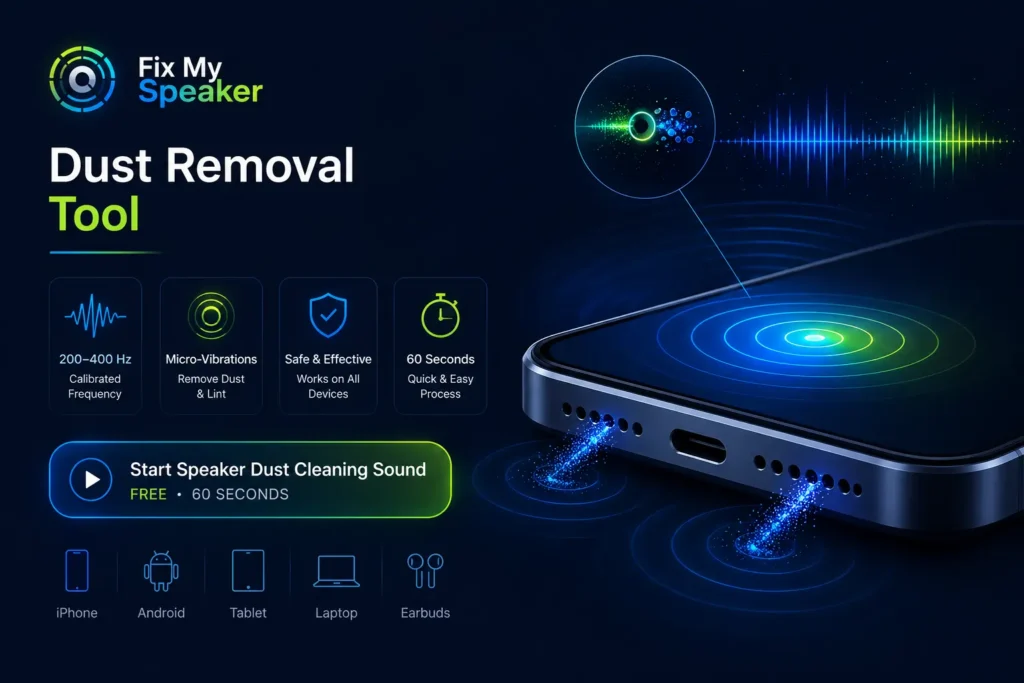
Dust Removal Tool
The speaker dust cleaning sound tool plays a calibrated frequency sweep between 200Hz and 400Hz — the resonant frequency range most effective for dislodging dry particles from smartphone speaker mesh. When this frequency hits the speaker diaphragm at its natural resonant point, it creates micro-vibrations strong enough to physically shake dust, pocket lint, and fine debris loose from the grille mesh and push it outward.
Open it in any browser. Remove your phone case. Set volume to maximum. Press play. The entire process takes 60 seconds and works on every iPhone, Android, tablet, laptop, and earbud — no app, no signup, no microphone access required.
Start Speaker Dust Cleaning Sound — Free, 60 Seconds
What Is Ear Speaker Dust Cleaning Sound Online?
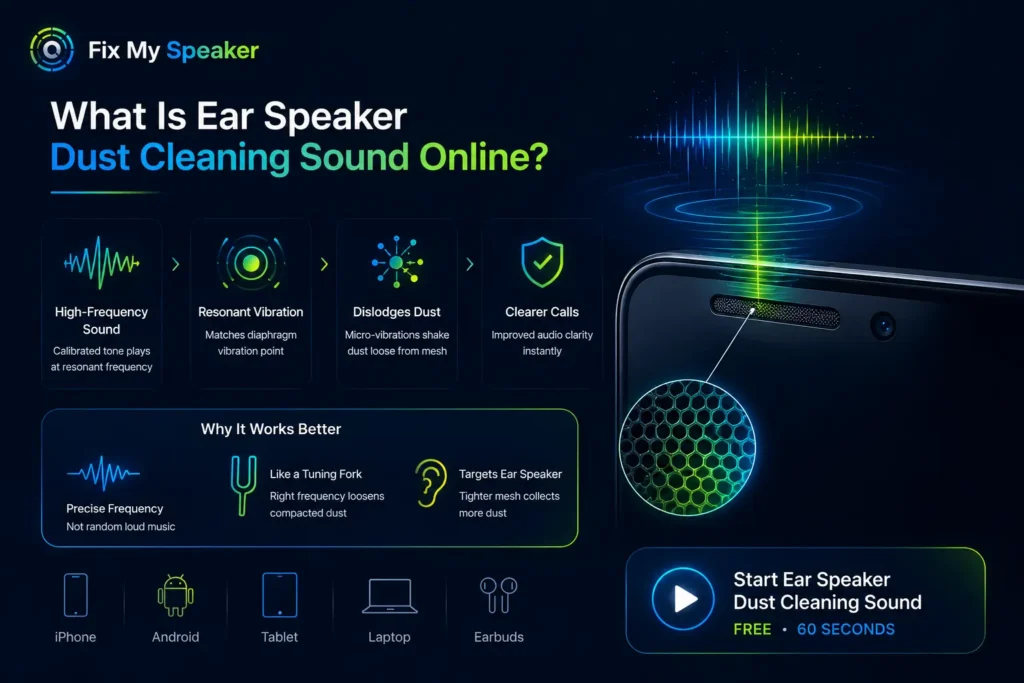
An ear speaker dust cleaning sound online is a precisely calibrated high-frequency audio tone played through your phone speaker at its resonant frequency. When the sound frequency matches the natural vibration point of the speaker diaphragm, the membrane oscillates with enough force to physically dislodge dust particles packed inside the speaker mesh.
Think of it like a tuning fork held against a dusty surface. The right frequency at the right amplitude creates vibration that loosens what was compacted and fixed. This is not random loud music — that creates uncontrolled turbulence that can pack dust tighter.
A speaker dust cleaning sound uses a specific frequency sweep matched to the diaphragm’s resonant range, which is why it works where high-volume playback does not.
The ear speaker — the small grille at the top of your phone used during calls — has tighter mesh weave than the main bottom speaker. It accumulates fine dust, skin oils, and debris faster and responds especially well to the higher-frequency range of the cleaning sweep. Most users notice call audio clarity improve immediately after the first ear speaker dust cleaning sound cycle.
How Does the Dust Cleaner Sound Work?
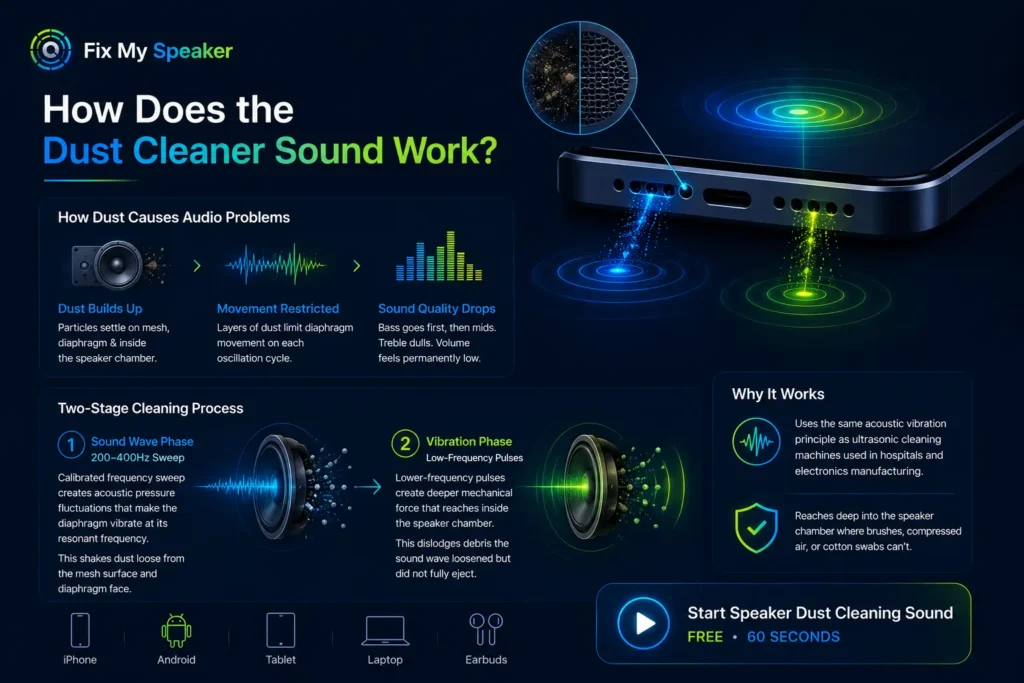
The speaker diaphragm is a thin membrane that moves air to create sound. Dust particles that enter through the speaker grille settle on the mesh surface, on the diaphragm face, and in the gap between the diaphragm and the speaker housing. Each layer of buildup restricts how far the membrane can move on each oscillation cycle.
Bass frequencies disappear first — they require the most diaphragm movement and are most sensitive to physical restriction. Mid-range clarity drops next. By the time treble sounds dull and volume feels permanently low, the blockage is typically severe.
The speaker dust cleaning sound works in two stages. The sound wave phase sweeps from 200Hz to 400Hz, creating acoustic pressure fluctuations that force the diaphragm to vibrate at its natural resonant frequency. This shakes dust particles loose from the mesh surface and the diaphragm face.
The vibration phase follows with lower-frequency pulses that create mechanical force reaching deeper into the speaker chamber — dislodging debris that the initial sound wave loosened but did not fully eject.
This is the same acoustic vibration principle behind precision ultrasonic cleaning equipment used in hospital instruments and electronics manufacturing. Applied to a phone speaker, it clears blockage that no brush, compressed air, or cotton swab can reach — because those methods only touch the outer grille surface.
How to Use Fix My Speaker’s Dust Cleaning Sound
Step-by-Step
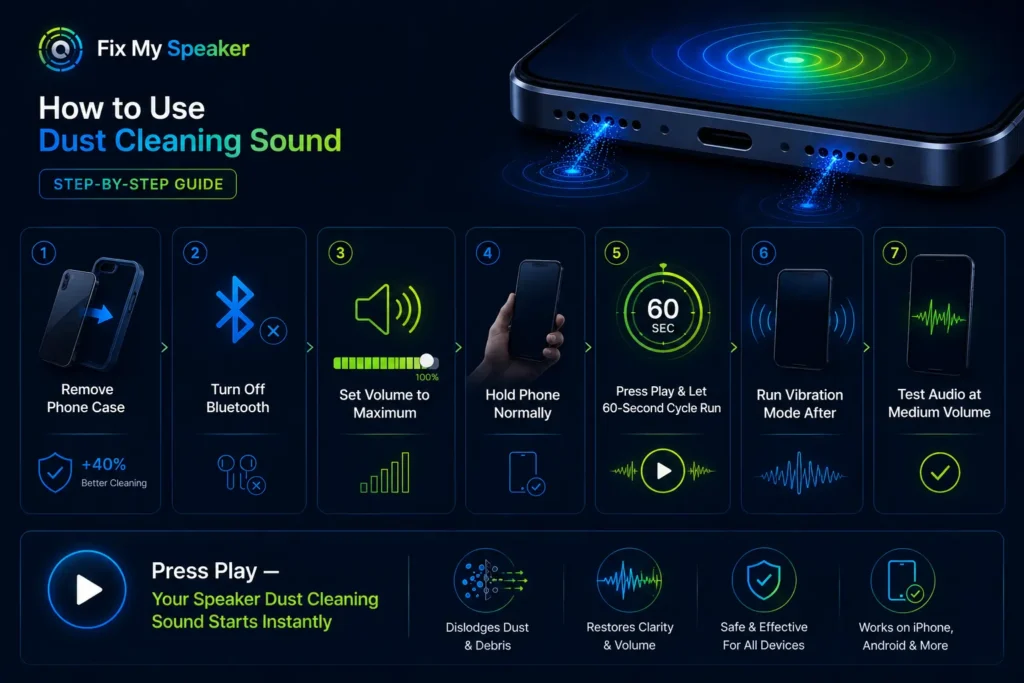
Step 1: Remove your phone case. Cases absorb vibration and reduce cleaning effectiveness by up to 40 percent. The acoustic energy needs to reach the speaker chamber directly.
Step 2: Turn off Bluetooth. Audio must route to the device speaker. If Bluetooth headphones are connected, the cleaning sound plays on those instead of your phone speaker. Disconnect everything before pressing play.
Step 3: Set volume to maximum. Maximum volume creates the strongest acoustic pressure. At 50 percent volume, vibration amplitude is too low to dislodge packed dust particles from the mesh surface. On Android, check that no system media volume limiter is capping output.
Step 4: Hold the phone normally. Unlike water ejection — where the speaker faces down to let gravity assist — dust cleaning works with the phone in normal orientation. The acoustic vibration dislodges particles regardless of gravity direction.
Step 5: Press play and let the full 60-second cycle run. The frequency sweep covers multiple resonant zones across the diaphragm and mesh. Stopping early cuts the deeper chamber pass short. Most users see fine particles exit the grille during the first 20 seconds.
Step 6: Run Vibration Mode immediately after. This second stage reaches deeper debris the sound wave pass loosened. The combination of both modes in sequence produces the most complete clean.
Step 7: Test audio at medium volume. Play a voice recording or short music clip. Restored bass, sharper treble, and clearer voice confirm the cleaning worked. Repeat the full cycle if improvement is partial.
Press Play — Your Speaker Dust Cleaning Sound Starts Instantly
Why Choose Fix My Speaker Over Other Speaker Cleaning Apps?
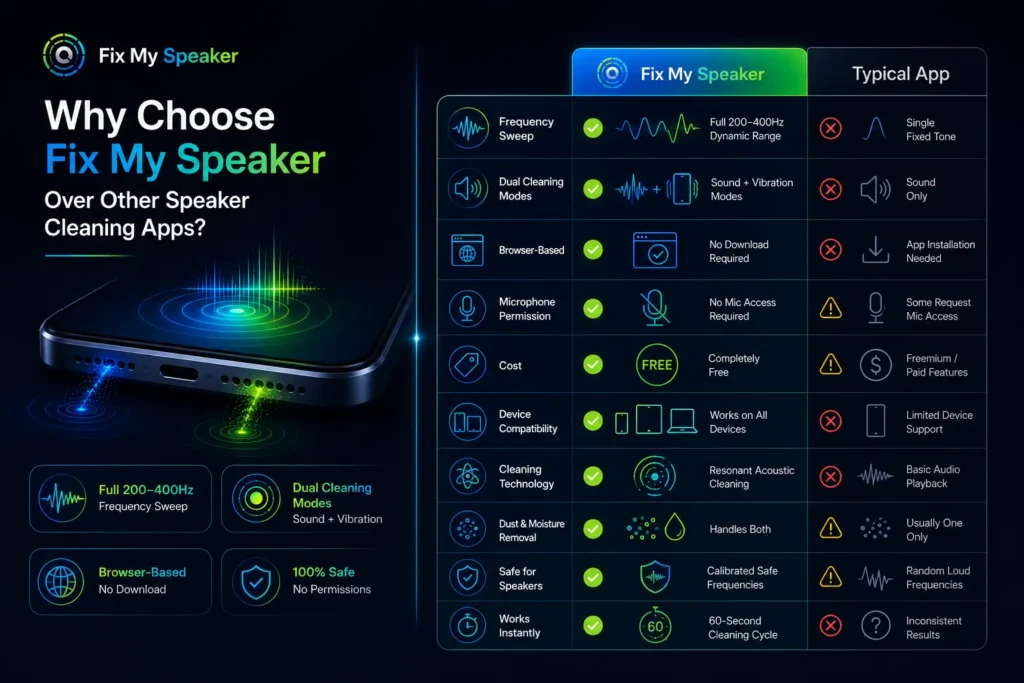
Most speaker cleaning apps play a single fixed tone. A fixed tone reaches one resonant point on the speaker membrane. Areas of the grille mesh and diaphragm that do not align with that single frequency receive no vibration at all — meaning half the blockage stays in place.
Fix My Speaker uses frequency cycling — a sweep across the full 200Hz–400Hz dust-cleaning range. Every zone of the speaker membrane and grille receives vibration. The result is more complete dust removal in a single session.
Other apps require installation, request unnecessary permissions including microphone access, or lock advanced modes behind paywalls. This tool runs entirely inside any browser, requests no permissions, accesses no device data, and costs nothing. The same acoustic principle powers every session regardless of device brand or model.
| Feature | Fix My Speaker | Typical App |
|---|---|---|
| Frequency Sweep | Full 200–400Hz Dynamic Range | Single Fixed Tone |
| Dual Cleaning Modes | Sound + Vibration Modes | Sound Only |
| Browser-Based | No Download Required | App Installation Needed |
| Microphone Permission | No Mic Access Required | Some Request Mic Access |
| Cost | Completely Free | Freemium / Paid Features |
| Device Compatibility | Works on All Devices | Limited Device Support |
| Cleaning Technology | Resonant Acoustic Cleaning | Basic Audio Playback |
| Dust & Moisture Removal | Handles Both | Usually One Only |
| Safe for Speakers | Calibrated Safe Frequencies | Random Loud Frequencies |
| Works Instantly | 60-Second Cleaning Cycle | Inconsistent Results |
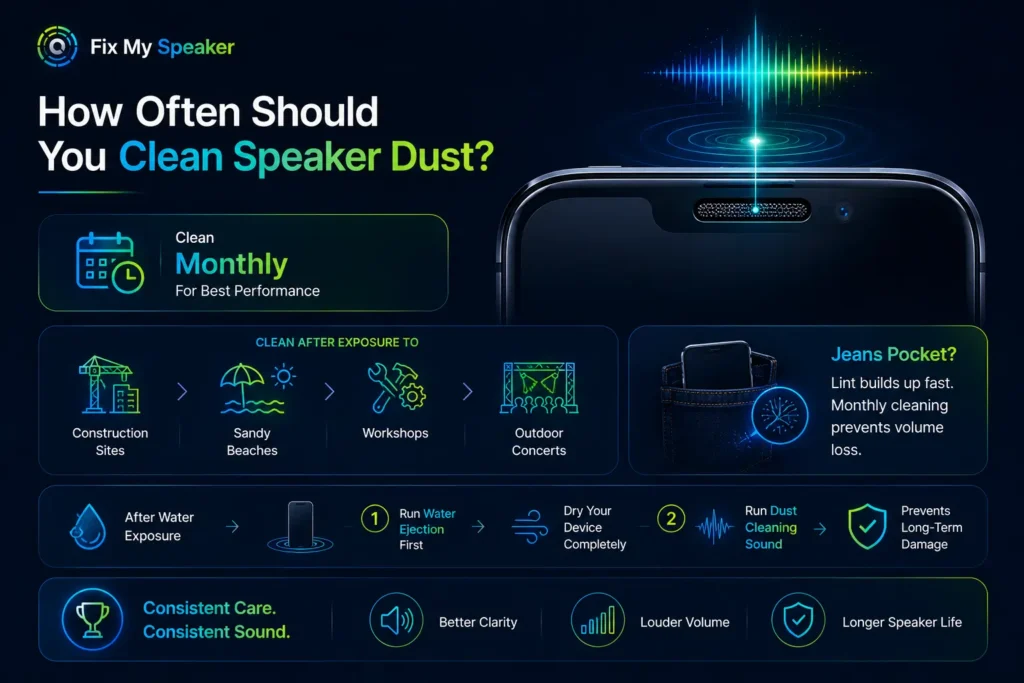
How Often Should You Clean Speaker Dust?
Monthly during normal indoor use. After any exposure to dusty environments — construction sites, sandy beaches, workshops, outdoor concerts — run a speaker dust cleaning sound session the same day. Fine airborne particles from these environments pack into the grille mesh faster than standard daily use.
If you carry your phone in a jeans pocket regularly, the lint and fabric fibre accumulation is faster than most users realise. A monthly cleaning session takes 60 seconds and prevents gradual volume loss from ever becoming noticeable. Users who clean monthly typically describe the results as minor but consistent — those who wait until audio is clearly muffled describe the improvement as dramatic.
After any water exposure, run the water ejection cycle first, then follow with a dust cleaning sound session once the device is dry. Water and dust together form a conductive paste inside the speaker chamber — cleaning both separately in the correct sequence prevents this combination from causing long-term diaphragm restriction.
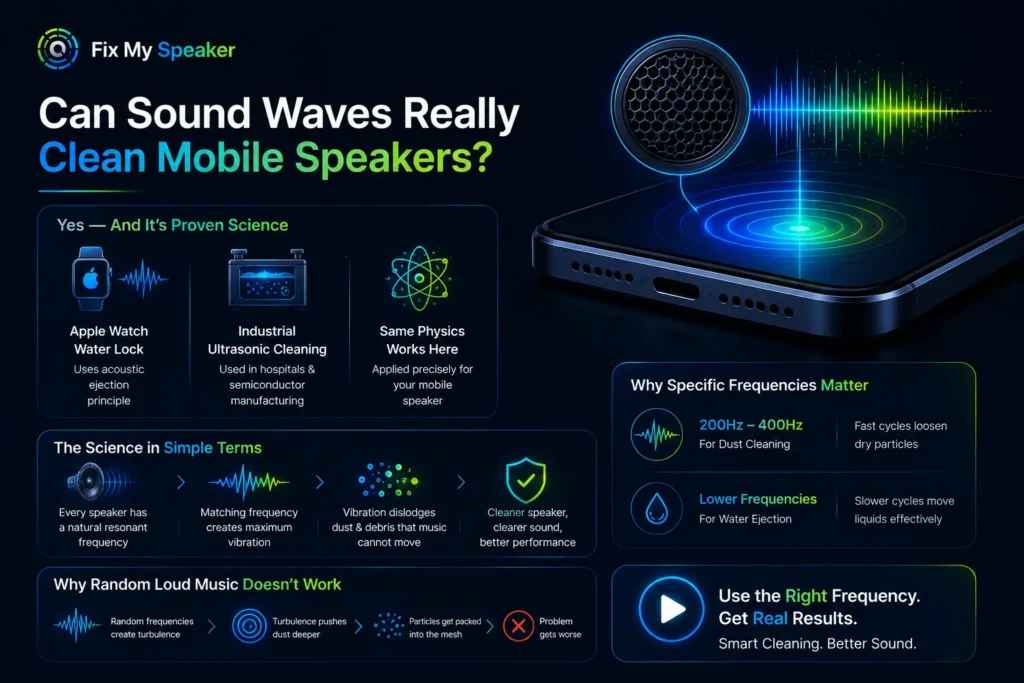
Can Sound Waves Really Clean Mobile Speakers?
Yes — and this is not a new concept. Apple built an acoustic ejection mechanism into the Apple Watch Water Lock feature using the same principle. Industrial ultrasonic cleaning equipment used in hospitals and semiconductor manufacturing applies identical physics at higher frequencies for precision instrument cleaning.
The science is straightforward: every speaker diaphragm has a natural resonant frequency. When an external sound frequency matches that resonant point, the membrane vibrates with greater amplitude than it does during normal audio playback. That amplified vibration creates enough mechanical force to dislodge particles that passive vibration from music cannot move.
The specific frequencies used — 200Hz to 400Hz for dust — are chosen because dry particles respond to faster vibration cycles than liquids do. This is why the dust cleaning sound uses a different frequency range than the water ejection tool.
Using the correct frequency for the correct debris type is what separates an effective acoustic cleaning tool from playing random loud music, which typically makes the problem worse by packing surface dust deeper through turbulent airflow.
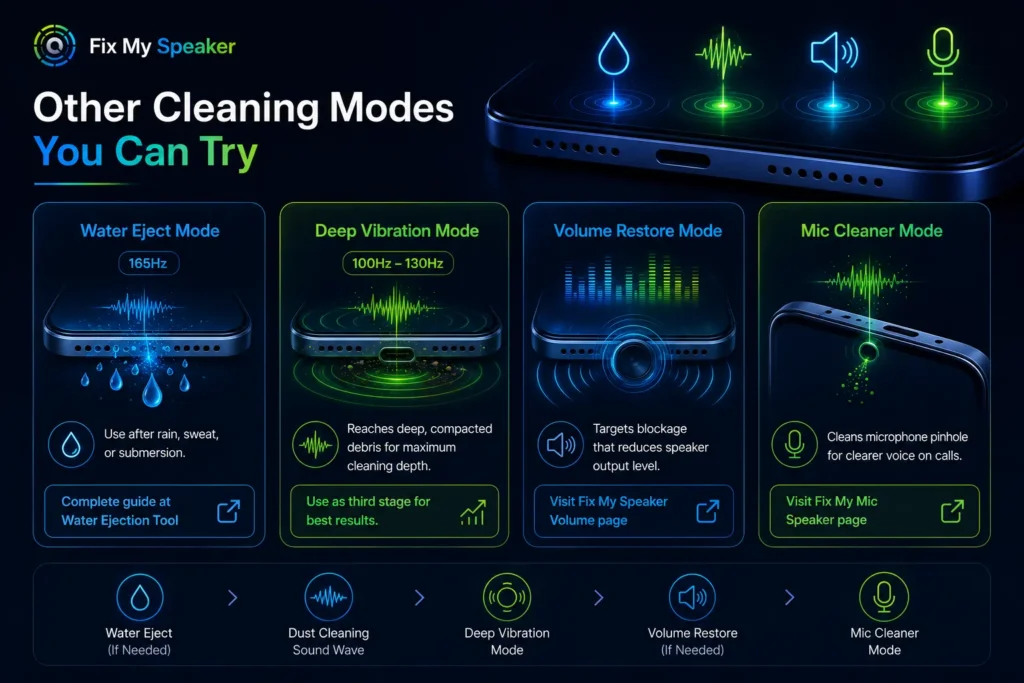
Other Cleaning Modes You Can Try
Water Eject Mode
targets moisture using the 165Hz resonant frequency — the acoustic sweet spot for breaking water’s surface tension and pushing liquid droplets out through the grille. Use this immediately after rain, sweat, or submersion exposure. For a complete guide, visit our water ejection tool.
Deep Vibration Mode
uses 100Hz–130Hz bass pulses to create mechanical force deeper inside the speaker chamber. This reaches compacted debris the standard dust cleaning sound loosened but did not fully eject. Run it as a third stage after the standard sound wave and vibration passes for maximum cleaning depth.
Volume Restore Mode
targets the specific frequency range most effective for blockage that has reduced speaker output level. If dust cleaning improves clarity but volume remains low, visit our Fix My Speaker Volume page for the dedicated volume restoration cycle.
Mic Cleaner Mode
addresses the microphone pinhole separately — a smaller opening that traps fine particles faster than the main speaker grille. If voice sounds muffled on calls after speaker cleaning, visit the Fix My Mic Speaker page.
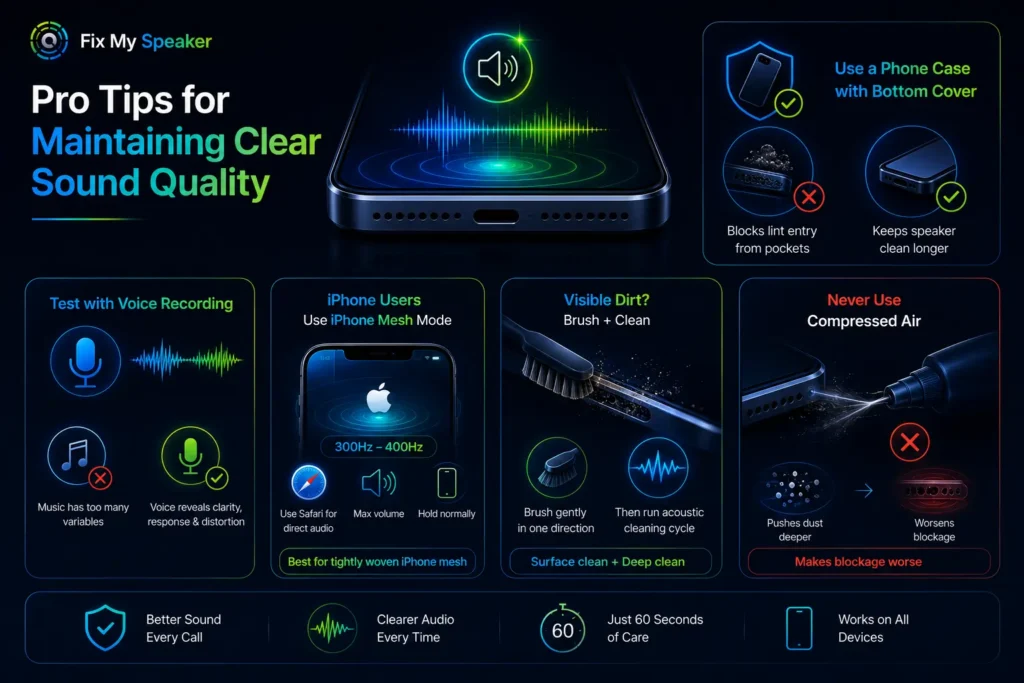
Pro Tips for Maintaining Clear Sound Quality
Use a phone case with a bottom port cover. Most lint accumulation enters the speaker grille from pocket fabric — a case that covers the bottom edge significantly slows this process between cleaning sessions.
After cleaning, test audio with a voice recording rather than music. Music has too many frequency variables to isolate speaker quality changes. A short voice recording at medium volume reveals clarity, frequency response, and distortion more clearly than any song.
For how to clean dust out of iPhone speakers specifically — Safari on iPhone routes audio directly to the device speaker without any additional settings. Run the speaker dust cleaning sound at maximum hardware volume in Safari, hold the phone normally, and allow the full cycle. For the tightly woven mesh of iPhone speakers, select the iPhone Mesh mode which uses a higher 300Hz–400Hz range optimised for Apple’s speaker grille structure.
For how to clean dirt out of iPhone speaker when the blockage is visible — use a dry, clean soft-bristle brush along the grille mesh in one direction before running the acoustic cycle. The brush dislodges surface material and the sound cycle clears what the brush cannot reach. Never use compressed air — it pushes surface dust through the mesh into the speaker chamber and makes the blockage worse.
Final Thoughts — Clean. Clear. Confident.
Dust is the most common and most overlooked cause of gradual audio quality loss in smartphones. It builds slowly, degrades sound incrementally, and reaches a tipping point where the change is sudden and obvious. The speaker dust cleaning sound stops that accumulation before it reaches that point.
One 60-second session monthly keeps the speaker grille clear, the diaphragm moving freely, and audio quality consistent. If you have been living with muffled sound, flat bass, or low call volume, run a session now. Most users hear the difference within the first 30 seconds.
For related issues, explore our dust removal guide, water ejection tool, and free speaker test tool to confirm audio quality after cleaning.
Dust particles accumulate on speaker membranes through
electrostatic attraction — a phenomenon explained in detail
by the Library of Congress science resources.